Google’s AI Advantage: How the Tech Giant Is Shaping the Future of Artificial Intelligence
- Editorial Team

- Jan 15
- 4 min read
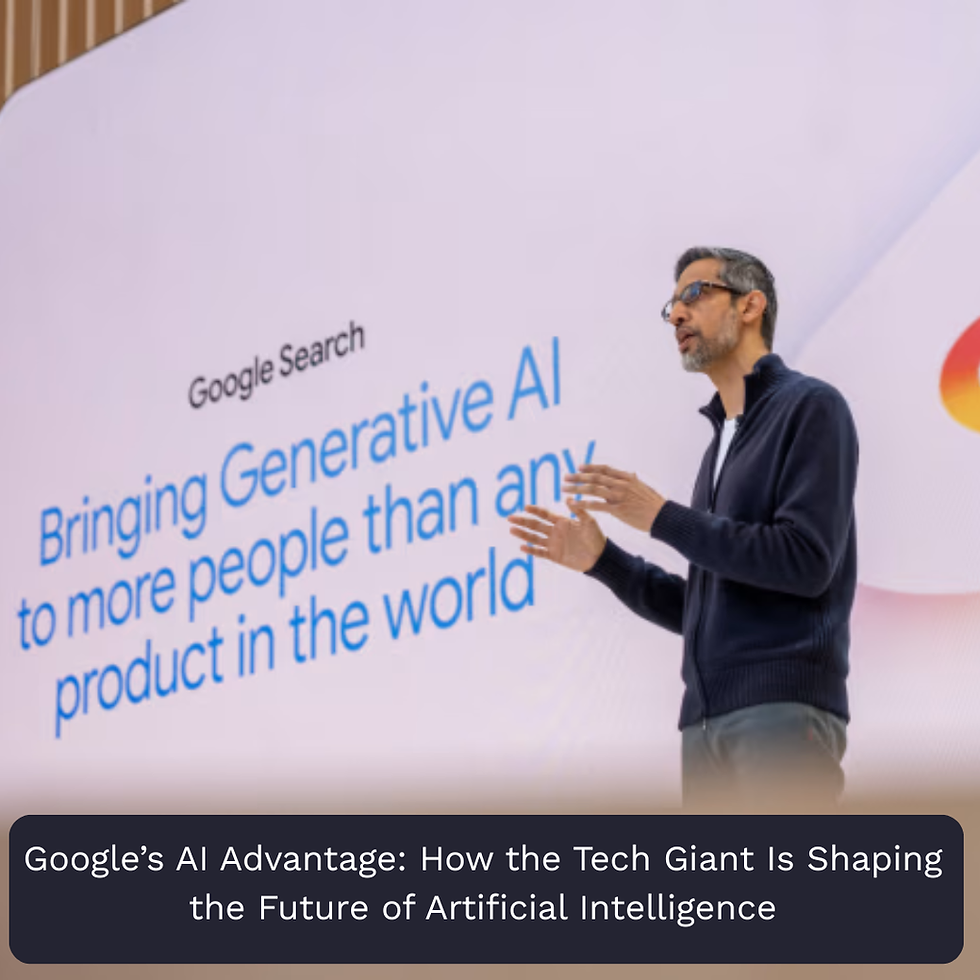
Google is deepening its lead in the artificial intelligence era, turning advances in generative models, integrated products and commercial partnerships into a strategic advantage that’s capturing the attention of Wall Street, rivals and regulators alike. Over the past year, the company has showcased momentum across its AI ecosystem — from consumer products and enterprise services to new applications in commerce and cloud computing — helping sustain its dominance in a field where competition is fierce and stakes are high.
At the heart of Google’s positioning is its Gemini AI platform, a next-generation suite of large language models and tools that the company has been rolling out across its services. Gemini is now central not just to Google Search and mobile experiences but also to broader commercial offerings — a shift that executives say will transform how people interact with information, conduct business and shop online.
One of the most visible markers of this AI push has been Google parent Alphabet’s market performance. The company recently crossed a $4 trillion market-cap milestone, becoming one of the few tech giants to achieve that valuation. Investors cited optimism about Alphabet’s AI strategy — particularly its ability to monetize Gemini and related cloud services — as a key driver behind the surge.
AI Integration Everywhere
Unlike many competitors that offer AI as standalone products or services, Google’s approach centers on embedding intelligence throughout its existing ecosystem. That means Gemini-powered AI isn’t a separate app users must learn — it’s built into Google Search, Gmail, Workspace apps, Chrome and other widely used products.
This integrated strategy creates a powerful “AI flywheel,” where data and usage feed continuous improvement and wider adoption. For example, millions of daily search queries inform AI models that, in turn, generate more accurate and context-aware responses — keeping users engaged and driving further usage. Industry analysts point out that this seamless integration is a distinct advantage over rivals whose AI capabilities require separate logins, accounts or learning curves.
Google’s AI features now include conversational search experiences, instant summarization of results and “agentic” capabilities that can complete multi-step tasks for users — ranging from drafting emails in Workspace to answering complex queries directly inside the search interface. While these innovations are still rolling out globally, adoption is growing rapidly and helping to expand Google’s influence in how people access knowledge and conduct tasks online.
From Search to Commerce
Google is also extending AI into commerce. At the recent Consumer Electronics Show (CES) and other industry forums, the company highlighted tools that leverage AI for personalized shopping experiences. These systems aim to help consumers move seamlessly from product search to purchase, integrating shopping recommendations and interactions within the AI experience itself. Partnerships with major retail chains suggest this isn’t theory — it’s a burgeoning business application being actively developed and tested.
This move into AI-powered commerce reflects a broader trend in the industry: technology companies are looking to use AI not just for answering questions, but for enabling transactions and revenue-generating workflows. By enabling retailers and brands to tap into AI agents that can understand shopper intent and preferences, Google is attempting to build a new commerce layer on top of its existing digital infrastructure.
Pressure on Rivals and Industry Reaction
Google’s advances have not gone unnoticed by competitors. Reports indicate that OpenAI — creator of ChatGPT — has declared an internal “code red” effort to accelerate its own AI development in response to Google’s expanding capabilities. While ChatGPT still retains a larger user base globally, Google’s integration into search, cloud and consumer devices has positioned it as a formidable alternative and, in some use cases, a preferred choice.
Other tech giants, including Apple, are also making strategic moves tied to Google’s AI momentum. A high-profile agreement will see Google’s Gemini models power the next generation of Apple’s Siri, bringing Google’s technology into a rival platform and underscoring the industry’s recognition of its AI prowess.
Challenges and Regulatory Scrutiny
Despite its growing influence, Google faces headwinds. Regulatory bodies in the European Union have opened investigations into how Google uses online content to power its AI services, raising potential antitrust concerns. Critics argue that AI features like generative summaries and AI-enhanced search may divert traffic from publishers’ websites, complicating digital content economics and raising broader questions about fair use and compensation.
In the U.S., Google has grappled with legal challenges tied to how its technology is deployed, though some courts have allowed core parts of its business to continue while regulatory reviews play out.
A Strategic Advantage Rooted in Scale
What sets Google’s AI strategy apart is not just the quality of its models — though those have improved significantly — but the scale and reach that the company brings to bear. By integrating generative AI across billions of daily interactions, Google isn’t just competing on technical merits; it’s shaping how digital experiences are delivered on a global scale.
For years, Google has dominated web search and advertising. Now it appears poised to carry that dominance into the next generation of computing, where answers — and actions — are increasingly driven by artificial intelligence rather than traditional search algorithms. Whether regulators, competitors or users will embrace this transition remains an open question, but for now, Google’s AI advantage looks both broad and deep.


Comments