Apple Brings AI Agents to Xcode, Letting Developers Hand Over Real Coding Tasks to Machines
- Editorial Team

- Feb 5
- 4 min read
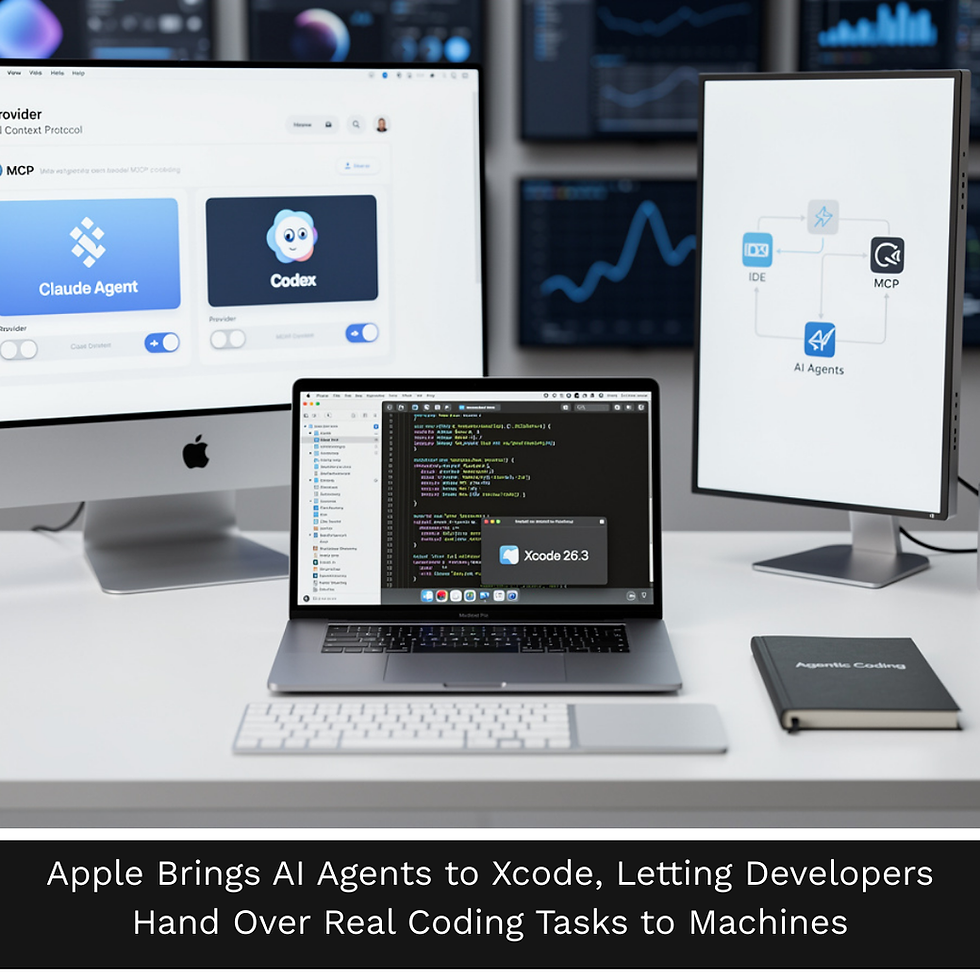
Apple is significantly advancing the role of artificial intelligence in software development by introducing agent-based AI tools directly into Xcode, its flagship development environment used for building apps across iPhone, iPad, Mac, Apple Watch and other Apple platforms. This update — now available as the Xcode 26.3 Release Candidate — goes well beyond simple code suggestions and places powerful autonomous AI functionality at the heart of developers’ workflows.
Traditionally, developers have relied on Xcode to write, compile, test, and debug applications manually. In recent years, Apple added basic AI assistance — letting models like ChatGPT or Claude answer coding questions or suggest snippets of code — but these features still required developers to do the heavy lifting. The latest update changes this dynamic by enabling agentic coding, where AI models can take actions on their own inside the IDE.
What Agentic Coding Really Means
Agentic coding turns AI from a passive assistant into an active partner that can perform complex development tasks with minimal human supervision. With Xcode 26.3, developers can integrate advanced AI models such as Anthropic’s Claude Agent and OpenAI’s Codex — both of which are designed to work autonomously in context — directly into the IDE. Unlike straightforward autocomplete or suggestion features, these agents can: search Apple’s documentation, understand project structure, generate code files, fix errors, update project settings, run builds and even verify code visually.
For example, an AI agent can be instructed to “add a new feature” or “fix a UI bug” using natural language commands. It will then explore the project’s full architecture, break down the task into actionable steps, generate code, run tests to verify functionality, and iterate until the desired result is achieved. Developers can follow this progress in real time through a transcript view inside Xcode, where each change is documented and reversible if needed.
This represents a significant leap forward from tools that only offer suggestions or small code completions. With agentic coding, AI becomes capable of longer-running, goal-oriented tasks — executing on developer intentions and providing finished or near-finished implementations.
Integrations and Standards: OpenAI, Anthropic, and MCP Support
A key enabler of this new workflow is Apple’s support for the Model Context Protocol (MCP) — an open standard that allows AI models to integrate deeply with Xcode’s internal tools. This means developers aren’t limited to just a couple of AI providers; any MCP-compatible agent can interact with the IDE, access documentation, analyse project files and participate in the development process.
To use these tools, developers connect their own API keys from OpenAI or Anthropic inside Xcode’s settings. Once connected, they can choose which agent to use for a given task and switch between models if desired. According to the integrated documentation, this setup encourages flexibility and avoids vendor lock-in, allowing the development community to experiment with a range of autonomous AI coding solutions.
Apple’s collaboration with both Anthropic and OpenAI highlights a broader shift in how major tech companies view AI in development workflows — moving from proprietary tools toward open, extensible ecosystems that accommodate multiple providers.
Real World Benefits for Developers
AI agents in Xcode promise several immediate advantages for developers of all skill levels:
1. Automation of Repetitive Tasks: Traditionally, developers would manually write and refactor boilerplate code, deal with project configurations, or hunt down correct API usage. With agentic coding, agents can handle many of these repetitive or detail-oriented tasks autonomously, freeing developers to focus on higher-level design, logic and innovation.
2. Faster Prototyping and Exploration: Developers can describe the functionality they want or give broad goals to an agent, then let it generate prototypes quickly. This can dramatically shorten iteration cycles and help validate ideas without lengthy manual coding sessions.
3. Learning and Onboarding: For junior programmers or those new to Apple’s platform, watching how an agent completes tasks — step by step — can be instructive. The transcripts and automatic summaries provide insight into how best to approach certain patterns or APIs.
4. Visual Feedback and Verification: Because the AI agents can access Xcode Previews and other visual tools, they’re able to verify UI work and adjust interfaces iteratively — a capability that goes beyond mere text-based code generation.
Industry Significance and What Comes Next
Apple’s adoption of agentic coding in its flagship IDE is more than a developer convenience — it signals a broader transformation in software engineering. By empowering AI to take on more complex tasks, Apple is acknowledging that future developers may spend less time manually writing every line of code and more time guiding intelligent systems to execute their intent.
This shift aligns with trends across the industry where autonomous tools are increasingly used to speed up workflows and lower barriers to entry. It also places pressure on traditional development platforms to offer similar capabilities, particularly as younger or less experienced developers gravitate toward environments where AI assistance is tightly integrated.
Importantly, Apple emphasizes that developers remain in control — agents act autonomously only when instructed, and detailed logs and undo options are built into Xcode so programmers can always review or reverse changes. This balance between autonomy and oversight reflects a pragmatic approach to integrating AI into professional workflows.
Conclusion
Apple’s introduction of AI agents into Xcode marks a defining moment in the evolution of software development tools. With Xcode 26.3 and support for agentic coding, developers now have access to autonomous capabilities that can handle complex workflows, reduce manual workloads and reshape how apps are built across the Apple ecosystem. By embracing open standards and multiple AI providers, Apple has also set a precedent for a more collaborative and flexible future for AI-powered development.


Comments