Google Cloud Goes All-In on AI Agents and Next-Gen Computing
- Editorial Team

- Apr 23
- 5 min read
Introduction
Google Cloud is going all out to get into AI agents and next-gen computing.
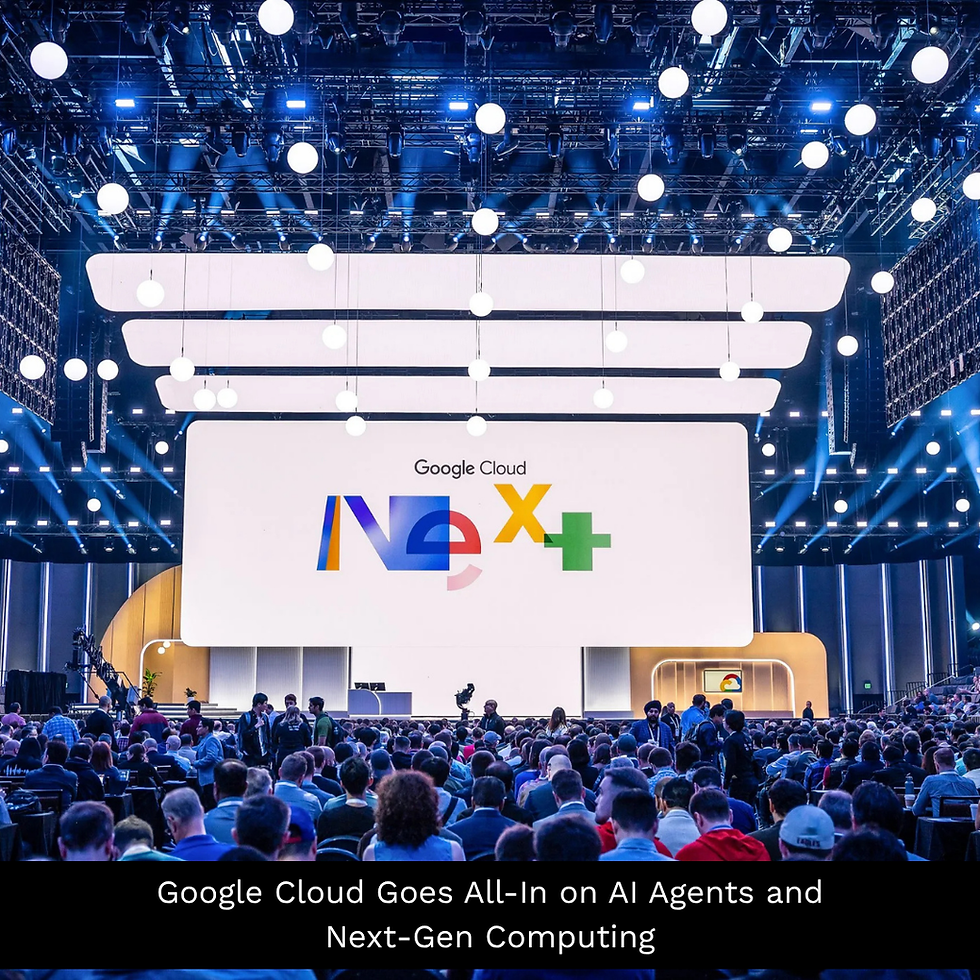
Google is changing the future of cloud computing by putting artificial intelligence, specifically AI agents, at the center of its strategy. At its most recent Cloud Next conference, the company showed off a mix of cutting-edge hardware, software platforms, and tools for businesses that it hopes will speed up what it sees as the next step in AI adoption: running tasks on its own at scale.
This change is a sign of a bigger change. The time when AI was just a test or helpful tool is coming to an end. Instead, Google is betting on a world where AI systems do tasks, manage workflows, and work with little help from people.
The Growth of AI Agents as Key Infrastructure
The main point of Google's announcement is a strong focus on AI agents, which are self-driving systems that can do complicated tasks instead of just following commands. These agents are not extras, but rather the building blocks of enterprise software.
Google made platforms that let companies build, deploy, and manage these agents on a large scale. The goal is to get businesses to what the company calls "agentic operations," where AI systems take care of all the steps in a process.
This method shows a bigger change in the industry. Software is becoming the operator itself instead of being used by people. AI agents are no longer just assistants; they are becoming their own independent actors in business systems.
There are already signs of early adoption. Businesses are starting to use hundreds of specialised agents in their operations, which shows that this model is not just a theory but is actually being used in the real world.
A New Kind of AI Hardware
Google showed off its eighth-generation Tensor Processing Units (TPUs), which are custom-built chips made just for AI workloads, to help with this change. There are two types of these chips:
TPU 8t: Best for training big AI models
TPU 8i: Made for inference, which makes it easy and quick to use in the real world
This difference is very important. Training and inference have very different needs. AI agents, especially those that work all the time, need inference capabilities that are fast and powerful.
Google says that performance and efficiency have gotten a lot better. The new chips work much better per watt and are designed to get around problems like limited memory, which often slow down AI systems.
The bigger picture is strategic: Google is putting a lot of money into owning all of AI, from the hardware to the software. This vertical integration lets it get the best price, performance, and scalability, which are all important in a market that is becoming more and more compute-intensive.
AI at Scale Requires Massive Compute Investment
A huge investment in infrastructure is behind these product announcements. Google has promised to spend between $175 billion and $185 billion on computing power, with a lot of that going to cloud and machine learning systems.
This amount of capital spending shows a basic truth: AI is not just a software problem; it is also a computing problem. As models get more complicated and AI agents work all the time, the need for processing power grows at an incredible rate.
Google is getting ready to compete more aggressively with companies like Amazon Web Services and Microsoft Azure by making its own chips and expanding its infrastructure. Both of these companies are also putting a lot of money into AI.
From Testing to Business Use
Moving from testing to production is a big part of Google's strategy. Company leaders say that the first stage of generative AI, which was all about demos and prototypes, is over. The goal now is to provide real business value on a large scale.
Google is focusing on enterprise-ready features like governance, security, and integration to help with this change. These are very important for big companies that need to safely and reliably use AI in complicated settings.
Security is becoming a big worry, especially. AI agents become more independent, which also brings new risks. Google is responding by using AI to manage AI by putting in place AI-driven security tools that watch for threats and protect against them.
AI Is Already Changing How Google Works
The move toward AI-driven execution isn't just for customers; it's already happening inside Google itself. The company says that AI systems now make up about 75% of its new code.
This number shows how much AI has become a part of everyday work. Tasks that used to take a lot of engineering work are now happening much faster, with some processes happening many times faster than they did before.
This internal use is proof that it works. Google is not only selling AI-powered systems; it is also running as an AI-powered company.
Competing in the AI Infrastructure Race
Google's move into AI agents and specialised hardware is also a sign of how the cloud market is getting more competitive. The company has made progress, but it still has less market share than the leaders in its field.
But AI is changing the way businesses compete. Google is trying to set itself apart from competitors that rely more on third-party hardware or have fewer products by focusing on agentic systems, custom silicon, and full-stack integration.
With the release of new TPUs and enterprise AI platforms, Google is now a strong competitor in both the infrastructure and application layers of the AI ecosystem.
The Bigger Shift: From Tools to Self-Driving Systems
Google's strategy shows that the whole industry is going in a different direction. Software is changing from something that people use to something that works for people.
There are a number of effects of this change:
User interfaces become less important as AI agents handle interactions
Pricing models may shift from access to outcomes
Computing becomes the main bottleneck, driving infrastructure investment
Security and governance become critical as systems gain autonomy
Google's announcements are more than just updates on new products; they show where the market is going.
Conclusion
Google Cloud's most recent push shows that enterprise technology is at a very important turning point. The company is trying to change the way software is made, deployed, and used by combining AI agents with high-performance computing infrastructure.
The plan is big and costs a lot of money, but it fits with a larger trend in the industry: the shift toward autonomous systems that can do tasks on their own at a large scale.
If this vision comes true, the role of software will change completely, and the companies that own the infrastructure will have a lot of power over how digital operations will work in the future.


Comments